
24/7 emergency response
Ceiling Water Damage Restoration Across NH, MA, ME, VT, CT and RI, from Ice Dams to Burst Pipes
Ceiling water damage spreads fast, from a stain overhead into insulation, drywall, and the rooms below. Peniel finds the source, dries the structure, and restores the ceiling for homes and businesses across New Hampshire, Massachusetts, Maine, Vermont, Connecticut, and Rhode Island.
Call (603) 541-7979 Available 24/7 · emergency crews on standbyGet help now
Thanks, we’ll be in touch quickly.
How it works
From First Call to a Dry, Restored Ceiling
- 01 Call 24/7 We answer around the clock. Water moving through a ceiling is treated as an emergency from the first call.
- 02 We Respond Fast A Peniel technician heads to your property right away, anywhere in New England.
- 03 Find and Stop the Source We trace the water back to its source above the ceiling, whether that is a roof leak, an ice dam, a burst pipe, or an overflow from the floor above, and stop it.
- 04 Dry the Structure We remove or dry the saturated insulation and drywall and dry out the cavity above the ceiling so mold does not follow.
- 05 Restore the Ceiling We repair and refinish the ceiling, returning it to the way it looked before the water came through.
- 06 Document for Insurance We record every step with photos and moisture readings for your insurance claim.

Ceiling Water Damage Restoration in NH, MA, ME, VT, CT and RI
A ceiling stain is the last thing to appear and the first thing you notice. Ceiling water damage has usually been tracking through the structure for a while by the time it shows on the surface, spreading further from the source with every hour it goes unfound. We find it and put it right across New Hampshire, Massachusetts, Maine, Vermont, Connecticut, and Rhode Island.
How Water Gets Into a Ceiling
Water reaches a ceiling a handful of ways, and the path it takes decides how much damage it does before you ever see a stain. Ice dams back meltwater up under the shingles and into the ceiling below. Roof leaks open up under snow load, around a chimney or vent, or where a shingle has lifted. A frozen or burst pipe in the floor or attic above lets go and drains straight down. An overflowing tub, toilet, dishwasher, or washing machine on the floor above finds the shortest route to the ceiling underneath.
Whatever the entry point, the water rarely drops straight down. It runs along the top of the drywall and follows the joists, wetting insulation and framing several feet from where it first got in. That is why the stain you see is almost never directly below the source, and why chasing the stain instead of the source leaves the real problem in place. The first job on any ceiling water damage call is to work backward from the symptom to the point of entry.
The Warning Signs to Act On
Ceiling water damage announces itself in stages, and the earlier you catch it the less it costs to put right. A brown or yellow ring is dried mineral residue left behind as water evaporates, and a ring that is still growing means water is actively moving above it. Paint that bubbles, blisters, or peels is lifting because the surface behind it is wet. A patch that feels soft or spongy has lost its bond, and a section that sags or bulges is holding a pocket of trapped water that can let go all at once.
A musty smell with no visible stain is its own warning, because it usually means water has been sitting in the cavity long enough for mold to start. If you see an active drip, set a bucket, move anything valuable out from underneath, and call. None of these signs improve on their own, and a ceiling that has already begun to sag should be treated as a safety issue rather than a cosmetic one.
Why Ceilings Fail Fastest in Winter
New England winters are hard on ceilings, and the reason sits on the roof above them. Snow stays for weeks, heat escaping from the living space warms the underside of the deck, and the snow melts from below. That meltwater runs down the slope until it reaches the cold overhang at the eaves, where it refreezes into a ridge of ice, an ice dam. Water backing up behind the dam has nowhere to go but sideways and up, under the shingles and through the roof deck into the ceiling below.
Freeze-thaw cycles make it worse by working at every small gap in the roof, and heavy snow load stresses the structure and opens seams that were watertight in summer. It adds up to a clear seasonal pattern. Ceiling water damage is the single most common interior loss we see from December through March, and it tends to arrive fast, often overnight, when a thaw or a warm spell follows a hard freeze.
What Ceiling Water Damage Restoration Involves
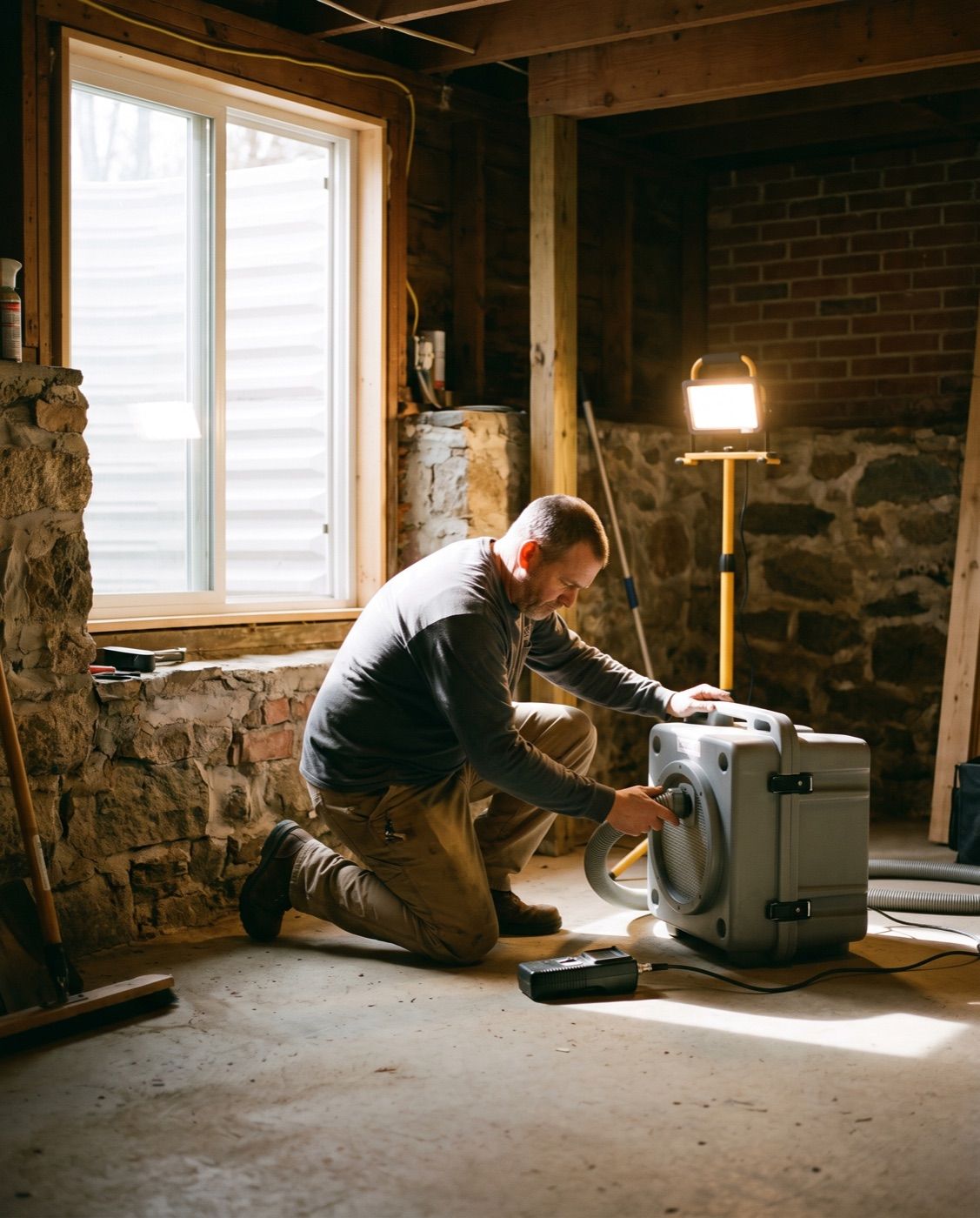
Restoration follows a strict order, and the order is what makes the repair last. We start by finding the source rather than the stain and stopping the water at its point of entry. Then we open the ceiling where we need to, pull out saturated insulation and any drywall too far gone to save, and set up drying equipment. We do not rely on how a surface looks or feels. We bring the framing and cavity down to a documented dry standard with moisture meters, the same discipline behind our water damage restoration work.
Only once the structure reads dry do we rebuild. We insulate, hang and finish new drywall, prime the affected areas with a stain-blocking sealer so the old marks cannot bleed through, and repaint so the ceiling matches the room again. Skipping the drying step to close the ceiling faster is the single most common reason ceiling water damage comes back, this time through fresh paint, a few weeks later.
Ceiling Water Damage and Mold
The space above a ceiling is one of the easier places in a house for mold to take hold. It is dark, still, poorly ventilated, and full of exactly what mold feeds on: paper-faced drywall, wood framing, and organic dust settled in the insulation. Add water and a day or two of warmth and growth can start before the surface below has even finished staining. Because it happens inside the cavity, you often cannot see it, only catch the musty smell it gives off.
That is why drying speed matters so much. The faster and more completely we dry the structure, the less chance a water problem has to become a mold problem, and the less likely you are to pay to open the same ceiling twice. When we do find growth already established, we contain and remediate it before any rebuild, rather than sealing it behind new drywall where it will keep spreading.
Insurance and Documentation
Most sudden ceiling water damage is the kind of loss a homeowners policy is designed to cover. A burst pipe, an appliance line that failed, or a storm-driven roof leak is generally treated as a sudden and accidental event, and that is what carriers pay on. What they will not pay on is neglect, so a slow drip left for months is often excluded. It is one more reason to act the moment a stain appears rather than watch it.
We build the claim as we work. We photograph the damage before and during the job, log moisture readings, and write up a clear scope so your adjuster has what they need to approve the work without back and forth. Keeping that record is often the difference between a claim that moves quickly and one that stalls, and it costs you nothing to have it done properly the first time.
Why Peniel
Trust Built on Standards, Not Slogans.
- 24/7 Emergency ResponseA saturated ceiling can give way. Real people answer day or night so we can be on site before the damage spreads.
- Local New England CrewsOur crews know the region’s housing stock and winter conditions, from the coast to the hill towns.
- We Find the Source, Not Just the StainA ceiling stain is a symptom. We trace the water to where it actually enters, so the repair holds.
- Documented for Your ClaimWe capture scope, moisture readings, and photos in writing, the detail an adjuster needs.
Common questions
Before You Call, the Honest Answers.
What causes water damage to a ceiling?
Most ceiling water damage in New England traces back to a roof leak, an ice dam in winter, a burst or frozen pipe, or an overflow from a bathroom or appliance on the floor above.
Is a stained or sagging ceiling an emergency?
A spreading stain means water is still moving, and a sagging or bulging ceiling can hold trapped water and give way. Both should be looked at right away.
Will you find where the water is coming from?
Yes. We trace the water back to its source above the ceiling and stop it before restoring the finish, so the problem does not return.
Do you work with insurance?
Often, yes. We document the damage, scope, and moisture readings in writing so you have what your adjuster needs.
How fast can you reach my property?
We respond around the clock across New England, and standard assessments are usually scheduled the same or next day.
Water Coming Through Your Ceiling?
Tell us what you are seeing and we will be on our way. Peniel handles ceiling water damage across New England, 24/7.
Prefer to talk? (603) 541-7979
Thanks, we’ll be in touch quickly.